The Statue of Liberty then and now tells one of the most fascinating stories in American history.
Before Lady Liberty became the green landmark recognized around the world, she was a massive construction project that crossed the Atlantic Ocean in hundreds of separate pieces.
The Statue of Liberty was built in France, shipped to the United States and carefully reassembled on what is now Liberty Island. It was officially dedicated on October 28, 1886.
More than 140 years later, the statue continues to welcome visitors to New York Harbor and represent freedom, hope and new beginnings.
But what did the Statue of Liberty look like during construction, why did it turn green, and how has it changed over the years?
Here is the incredible story behind the transformation.
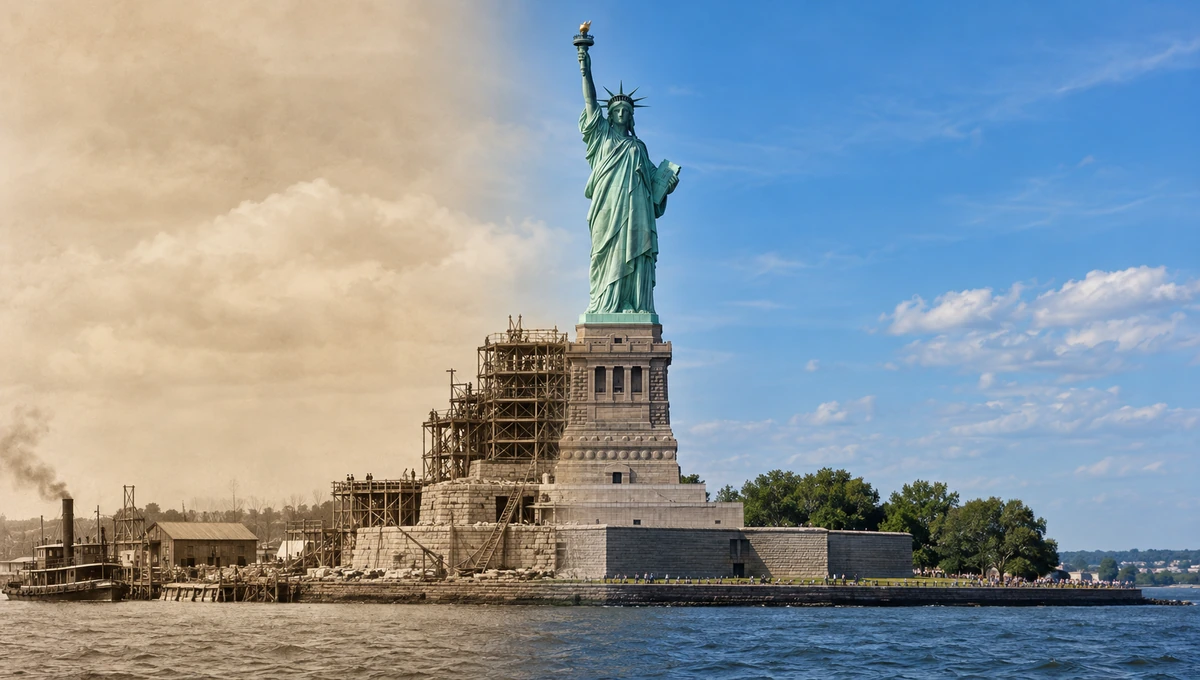
Statue of Liberty Then vs. Now: The Quick Answer
In the 1880s, the Statue of Liberty was a newly built copper structure waiting to be placed on its enormous pedestal in New York Harbor.
Today, it is a protected national monument and one of the most famous attractions in the United States.
The most noticeable difference is its color. The statue originally had a shiny copper appearance. Over time, exposure to air, moisture and the harbor environment created the familiar green outer layer called a patina.
This natural coating now helps protect the copper underneath.
Also Read: 11 Most Beautiful Sculptures — And They Left Me Speechless
Was the Statue of Liberty Built in 1884?
Not exactly.
The Statue of Liberty was constructed in France between the 1870s and 1884. French artisans began working on different parts of the statue years before it was completely assembled.
By 1884, the full statue had been assembled in Paris and formally presented to the United States.
Meanwhile, construction of the pedestal began in the United States during 1884. The pedestal was built inside the courtyard of Fort Wood, an older star-shaped fort on Bedloe’s Island.
Therefore, 1884 represents two important moments:
- The statue was completed and assembled in Paris.
- Construction of its pedestal began in New York.
The completed statue was later taken apart so it could be transported across the Atlantic.
Who Designed the Statue of Liberty?
French sculptor Frédéric Auguste Bartholdi designed the Statue of Liberty.
Its official name is Liberty Enlightening the World.
The statue was a gift from the people of France to the people of the United States. It celebrated the friendship between the two countries while honoring the ideas of liberty and democracy.
Bartholdi designed the enormous figure, while engineer Gustave Eiffel helped develop its internal metal framework. Eiffel later became famous for creating the Eiffel Tower in Paris.
The internal structure was an important engineering achievement. It allowed the statue’s copper exterior to move slightly during strong winds without damaging the entire monument.
How Was the Statue of Liberty Constructed?
The statue was not carved from one giant piece of material.
Workers created its outer surface from thin sheets of copper. These sheets were carefully shaped and attached to a metal supporting structure.
Different parts of the statue were completed and displayed before the full monument was ready.
The arm holding the torch was shown at the Centennial Exposition in Philadelphia in 1876. The statue’s head and shoulders were displayed at the Paris Universal Exposition in 1878.
These public exhibitions helped attract attention and raise money for the project.
The entire statue was eventually assembled in Paris between 1881 and 1884. It towered above nearby buildings and gave people their first look at the completed Lady Liberty.
How Did the Statue Travel from France to New York?
After the statue was completed in France, workers had to take it apart again.
The monument was separated into approximately 350 individual pieces and packed into 214 crates. The crates were loaded onto the French ship Isère for the journey across the Atlantic Ocean.
The ship arrived in New York Harbor on June 17, 1885.
However, the pedestal was not ready when the statue arrived. Its pieces had to remain in storage while American workers finished the base.
Once the pedestal was completed, workers began reassembling the statue on Bedloe’s Island.
How Was the Pedestal Funded?
France was responsible for financing the statue, while Americans were expected to pay for its pedestal.
Fundraising in the United States proved difficult. The project faced delays because the organizers did not have enough money to complete the base.
Newspaper publisher Joseph Pulitzer eventually launched a major fundraising campaign through his newspaper, the New York World.
He encouraged ordinary Americans to donate, even if they could contribute only a small amount. More than 120,000 people responded to the campaign.
The effort helped raise the money needed to finish the pedestal and became an early example of public crowdfunding.
When Was the Statue of Liberty Dedicated?
The pedestal was completed in April 1886.
Workers then reassembled the statue and attached it to the supporting framework. President Grover Cleveland officially dedicated the Statue of Liberty on October 28, 1886.
Thousands of people attended the celebration despite rainy and foggy weather.
A large naval parade traveled through New York Harbor, and celebrations were held throughout the city.
That dedication transformed the construction project into a national landmark.
Why Did the Statue of Liberty Turn Green?
The Statue of Liberty did not arrive in New York with its familiar green color.
Its exterior is made of copper, so the newly completed statue originally had a reddish-brown metallic appearance similar to a new copper coin.
Over several decades, the copper reacted with oxygen, moisture and other elements in the atmosphere. This chemical process created a green protective coating known as patina.
The color change happened gradually. By the early 1900s, much of the statue had developed its recognizable blue-green appearance.
Although there were discussions about removing the color, officials learned that the patina protected the underlying copper from further corrosion.
The green surface was therefore left in place.
How Has the Statue of Liberty Changed?
Lady Liberty’s general appearance has remained recognizable, but several important changes have taken place.
The original torch was replaced
The original torch was altered several times after the statue opened. Those modifications allowed water to enter and contributed to damage.
During the statue’s major centennial restoration, the original torch was removed and replaced with a new torch covered in gold leaf.
Visitors can now see the original torch inside the Statue of Liberty Museum.
Bedloe’s Island became Liberty Island
For most of the statue’s early history, its home was known as Bedloe’s Island.
The island was officially renamed Liberty Island in 1956, giving it a name more closely associated with the monument.
The statue received a major restoration
A large restoration project took place before the statue’s 100th anniversary.
Engineers and craftspeople repaired its internal structure, replaced damaged components and installed the new torch.
The restored Statue of Liberty reopened during its centennial celebration on July 4, 1986.
A new museum was added
The Statue of Liberty Museum opened on Liberty Island in 2019.
The museum explains the monument’s construction, history and changing meaning. Its most famous artifact is the statue’s original torch.
Admission to the museum is included with standard ferry access to Liberty Island.
What Does the Statue of Liberty Represent?
The Statue of Liberty was originally intended to represent liberty and democratic ideals.
Its meaning expanded over time.
During the late 1800s and early 1900s, millions of immigrants traveled through New York Harbor on their way to nearby Ellis Island. For many of them, the statue was one of the first major American landmarks they saw.
It came to symbolize:
- Freedom
- Democracy
- Hope
- Opportunity
- Immigration
- Friendship between France and the United States
- A new beginning in America
The broken chain and shackle near the statue’s feet also symbolize freedom from oppression.
What Do the Crown, Torch and Tablet Mean?
Almost every major part of the statue carries a symbolic meaning.
The torch
The raised torch represents enlightenment. It suggests that liberty can guide people out of darkness.
The crown
The statue’s crown has seven rays. These rays are commonly associated with the seven continents and seven seas, emphasizing the universal idea of liberty.
The tablet
Lady Liberty holds a tablet in her left hand.
It is marked with the Roman numerals JULY IV MDCCLXXVI, which represent July 4, 1776—the date associated with the adoption of the United States Declaration of Independence.
The broken chains
Broken chains and shackles appear near the statue’s feet. They represent liberation from tyranny and oppression.
How Tall Is the Statue of Liberty?
From the ground to the tip of the torch, the entire monument stands approximately 305 feet tall.
The statue itself, measured from its heel to the top of its head, is approximately 111 feet tall.
Its enormous size is sometimes difficult to understand from photographs. The tablet alone is more than 23 feet tall, and the index finger is about eight feet long.
Can You Visit the Statue of Liberty Today?
Yes. Visitors can reach Liberty Island only by ferry.
Authorized ferries depart from:
- The Battery in Manhattan, New York
- Liberty State Park in Jersey City, New Jersey
Standard ferry tickets include access to the grounds of Liberty Island, the Statue of Liberty Museum and the Ellis Island National Museum of Immigration.
Pedestal and crown access require special reservations. These tickets are limited and may sell out well in advance.
Purchase tickets only through the authorized ferry provider listed by the National Park Service.
Tips for Visiting the Statue of Liberty
Book early
Reserve crown or pedestal tickets as early as possible. Crown access is particularly limited.
Choose an early ferry
An early departure provides more time to explore both Liberty Island and Ellis Island in one day.
Allow several hours
Plan at least four to five hours if you want to explore both islands and their museums without rushing.
Prepare for security screening
Visitors must pass through airport-style security before boarding the ferry. Additional screening may be required before entering the pedestal or crown.
Wear comfortable shoes
A visit can involve considerable walking and standing. Crown admission also requires climbing a long, narrow staircase.
Check the weather
Many of the best views are outdoors. Wind, rain, heat and cold can affect the experience.
Interesting Statue of Liberty Facts
- Its official name is Liberty Enlightening the World.
- It was a gift from the people of France.
- Frédéric Auguste Bartholdi designed the statue.
- Gustave Eiffel helped create its internal framework.
- It arrived in New York Harbor in 350 pieces packed inside 214 crates.
- President Grover Cleveland dedicated it on October 28, 1886.
- The monument was designated a national monument in 1924.
- Bedloe’s Island was renamed Liberty Island in 1956.
- Its green color comes from a protective patina that developed over the copper.
- The original torch is displayed inside the Statue of Liberty Museum.
- The statue underwent a major restoration before its 1986 centennial.
- Visitors must take a ferry to reach Liberty Island.
Frequently Asked Questions
Q. Was the Statue of Liberty originally green?
A. No. Its copper surface originally had a reddish-brown appearance. Natural chemical reactions gradually created its green patina.
Q. Was the Statue of Liberty built in New York?
A. The statue was designed and constructed in France. It was shipped to New York in pieces and reassembled on its American pedestal.
Q. Why was 1884 important?
A. The statue was completely assembled in Paris in 1884. Construction of its pedestal in New York also began during that year.
Q. When did the Statue of Liberty arrive in America?
A. The ship carrying its disassembled pieces arrived in New York Harbor on June 17, 1885.
Q. When did the Statue of Liberty open?
A. The statue was officially dedicated on October 28, 1886.
Q. Can visitors enter the Statue of Liberty?
A. Yes. Visitors may reserve pedestal or crown access. These reservations are limited and should be booked in advance.
Q. Is Ellis Island included with a Statue of Liberty ticket?
A. Standard authorized ferry tickets include stops at Liberty Island and Ellis Island, along with access to their museums.
The Statue of Liberty’s Incredible Transformation
The transformation of the Statue of Liberty from an ambitious French construction project into an American icon is remarkable.
In 1884, the completed statue stood in Paris while workers in New York began building the pedestal that would support it. It was later dismantled, transported across the Atlantic and carefully rebuilt in New York Harbor.
Today, its green copper figure remains one of the most recognizable landmarks in the world.
The Statue of Liberty has changed in color, undergone major restoration and welcomed generations of visitors. However, its central message of liberty, hope and opportunity continues to make it meaningful more than a century after its dedication.

Florida Is Hosting a Free Air Show With the Blue Angels and Thunderbirds This October
8 Incredible Places in Florida You Need to Experience at Least Once