PALM BEACH COUNTY, Fla. — Nine people died in a devastating private jet crash in South Florida on November 1, 2026.
Now, attention is turning to another person connected to the tragedy: an air traffic controller who communicated with the aircraft before it went down.
An unconfirmed report attributed to iSource News claims that the controller is seeking permanent disability benefits after experiencing psychological trauma related to the accident.
The claim has not been independently verified by the Federal Aviation Administration (FAA), the National Air Traffic Controllers Association (NATCA), or other established news organizations.
However, the story has brought renewed attention to an important and often overlooked issue in aviation: the emotional impact that fatal accidents can have on the professionals working behind radar screens.
For air traffic controllers, an emergency does not always end when radio contact is lost.
Sometimes, the memory of those final conversations can remain long afterward.
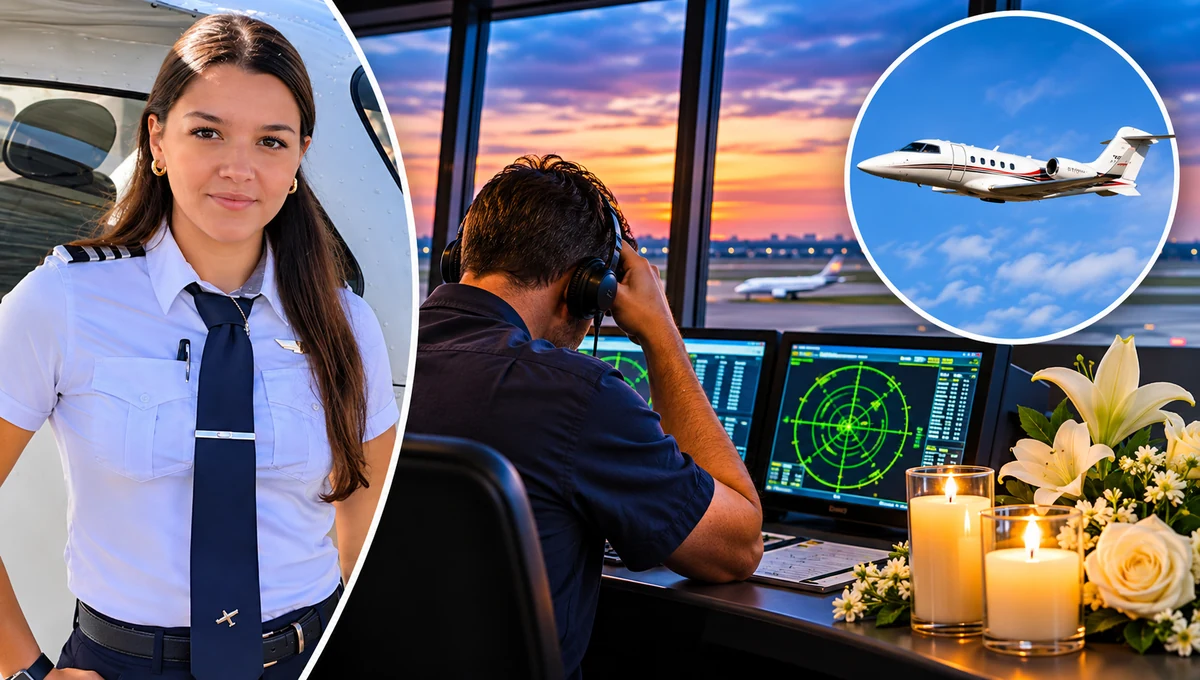
What Happened in the November 1 Florida Learjet Crash?
On Sunday, November 1, 2026, a Learjet 60 business jet crashed in Palm Beach County, Florida, while traveling from Austin, Texas, to North Eleuthera in the Bahamas.
The aircraft, registered N722BD, was carrying seven passengers and two crew members.
All nine people aboard died.
The crash occurred near Greenacres, southwest of West Palm Beach, after the aircraft encountered dangerous conditions during its flight.
According to information released during the investigation, the flight crew reported ice accumulation and turbulence before the aircraft began descending rapidly.
The crew declared an emergency as the situation deteriorated.
The jet subsequently crashed near a residential area, causing a fire and scattering debris.
The National Transportation Safety Board (NTSB) launched an investigation to determine what caused the accident.
Investigators have been examining weather conditions, aircraft performance, flight crew actions and the possibility of structural damage before impact.
A final determination of the cause has not been announced.
Also Read: Nationwide Blackout on November 17, 2026? Here’s What FEMA Actually Announced
A 20-Year-Old Co-Pilot Was Among the Victims
One of the nine people killed was 20-year-old co-pilot Nathalia Gadelha Filgueiras.
The young aviator, who had connections to Boca Raton, Florida, was identified by her family following the accident.
Filgueiras had developed a passion for aviation at a young age and pursued the training necessary to become a professional pilot.
Her former flight instructor later described her as a talented and dedicated aviator.
According to reporting on the investigation, Filgueiras was communicating with air traffic control as the aircraft encountered serious difficulties.
Those radio transmissions have become an important part of understanding the aircraft’s final moments.
For her family, fellow pilots and the wider aviation community, the tragedy represents the loss of a young woman whose aviation career had only recently begun.
What Is Being Reported About the Air Traffic Controller?
A report attributed to iSource News claims that an air traffic controller involved in communications with the Learjet is seeking permanent disability because of psychological trauma following the crash.
The report suggests the emotional impact of the incident may have affected the controller’s ability to continue working.
However, several important details remain unconfirmed.
There has been no independently verified public confirmation that the controller has applied for permanent disability benefits, received a particular medical diagnosis, or been determined unable to return to duty.
The controller’s identity, employment status and medical circumstances have also not been established through reliable public reporting.
The claim should therefore be treated as an allegation reported by one outlet, rather than a confirmed development.
There is also no basis for concluding that the controller caused or contributed to the crash.
The NTSB investigation is responsible for determining the accident’s circumstances and contributing factors.
The People Behind the Radar Screens
When an aircraft experiences an emergency, pilots depend on air traffic controllers for information, coordination and assistance.
Controllers may help crews navigate around dangerous weather, identify nearby airports, coordinate emergency services and manage other aircraft in the surrounding airspace.
Their work requires intense concentration and the ability to make decisions under pressure.
But the person speaking through a headset is still human.
During a serious emergency, a controller may hear pilots report mechanical problems, severe weather, loss of control or rapidly deteriorating conditions.
The controller may continue trying to assist until communication is lost.
Even when every available procedure is followed correctly, the emotional consequences of a fatal accident can be significant.
Controllers may later replay conversations in their minds, question their decisions or struggle with the knowledge that people died despite their efforts.
Experiencing those reactions does not establish that a controller made a mistake.
It reflects the psychological demands of working in a profession where emergencies can have life-or-death consequences.
Can Aviation Accidents Cause Psychological Trauma for Controllers?
Yes. Critical incidents can affect air traffic controllers’ mental health.
The aviation industry recognizes that serious accidents, near collisions and other traumatic events can produce stress reactions among personnel.
These reactions can include difficulty sleeping, anxiety, trouble concentrating, intrusive memories and emotional distress.
Not everyone responds to traumatic events in the same way.
Some controllers may recover with time and support, while others may need additional professional assistance.
The existence of dedicated support programs demonstrates that aviation organizations recognize the problem.
The National Air Traffic Controllers Association maintains a Critical Incident Stress Management program specifically designed to assist controllers following difficult experiences.
The program provides confidential, nonjudgmental support from trained fellow controllers.
What Support Is Available to Air Traffic Controllers?
NATCA’s Critical Incident Stress Management program, commonly called CISM, is designed to help controllers cope with stressful workplace events.
The program can assist after:
- Fatal aircraft accidents
- Serious aviation incidents
- Near collisions and other dangerous events
- The death of a colleague
- Natural disasters
- Other traumatic experiences affecting a controller’s well-being
Support may involve confidential telephone conversations or assistance from trained peers who understand the demands of air traffic control.
NATCA also explains that stress reactions can appear days, weeks or even months after a traumatic event.
That means someone who initially appears calm and professional may experience emotional difficulties later.
Peer support does not replace medical treatment when professional care is necessary, but it can provide an important first step toward recovery.
Why the Florida Crash Raises a Bigger Question
When an aircraft crashes, public attention naturally focuses on the victims, their families, the investigation and the circumstances leading to the accident.
Those are essential parts of the story.
But aviation tragedies can also affect people who were never aboard the aircraft.
Air traffic controllers, emergency dispatchers, firefighters, paramedics, investigators and other responders may experience the consequences of a disaster in different ways.
Some witness devastating scenes.
Others hear distress calls or attempt to coordinate help while an emergency unfolds.
The emotional burden of those experiences can continue after the immediate response is over.
The unverified report about the Florida controller highlights why confidential mental health resources are important for aviation and emergency professionals.
It also raises a question worth discussing: Are the people responsible for helping others during emergencies receiving enough support afterward?
What Are Investigators Looking Into?
The NTSB continues investigating the Learjet 60 crash.
Among the issues under examination are the weather conditions the aircraft encountered, reports of icing and turbulence, the aircraft’s rapid descent and evidence suggesting parts of the jet may have separated before impact.
Investigators are also reviewing available communications and other flight information to reconstruct the sequence of events.
The fact that a controller communicated with the aircraft does not establish any responsibility for the accident.
Likewise, a report about a possible disability claim cannot be used to draw conclusions about the controller’s performance.
Determining what happened requires evidence gathered through the official investigation.
Nine Lives Lost, and a Community Left Grieving
At the center of the story are the nine people who lost their lives.
The victims included experienced aviation professionals, a young co-pilot and passengers who were traveling toward the Bahamas.
Their deaths have affected families, friends, colleagues and communities far beyond the crash site.
The tragedy also disrupted the surrounding neighborhood, where emergency crews responded to fires, debris and damage after the aircraft struck the ground.
For those who lost loved ones, the investigation may eventually provide answers about what happened.
But those answers cannot undo the loss.
As the aviation community continues to mourn, the discussion about mental health support serves as a reminder that the consequences of a disaster can extend beyond the people directly involved.
Frequently Asked Questions
Q. When did the Florida Learjet crash happen?
A. The Learjet 60 crashed on November 1, 2026, in Palm Beach County, Florida.
Q. How many people died?
A. All nine people aboard the aircraft died, including seven passengers and two crew members.
Q. Who was the young co-pilot?
A. The co-pilot was 20-year-old Nathalia Gadelha Filgueiras, whose family confirmed her identity after the crash.
Q. Is the air traffic controller permanently disabled?
A. That has not been independently confirmed. A report attributed to iSource News claims the controller is seeking permanent disability, but no verified public confirmation has established the claim.
Q. Did air traffic control cause the crash?
A. There is no established finding that the controller caused the accident. The NTSB investigation remains ongoing.
Q. Can air traffic controllers develop trauma after fatal accidents?
A. Yes. Serious aviation incidents can cause psychological distress, and NATCA operates a dedicated Critical Incident Stress Management program to support affected controllers.
Q. What caused the Learjet to crash?
A. The final cause has not been determined. Investigators are examining weather, icing, turbulence, aircraft performance and other evidence.
Final Thoughts
The November 1 Learjet crash claimed nine lives and left families and communities facing an unimaginable loss.
The unconfirmed report concerning an air traffic controller’s possible disability claim has introduced another difficult dimension to the tragedy.
Behind every radar screen is a person trained to remain calm when others are facing danger.
But remaining professional during an emergency does not mean being unaffected by what happens afterward.
As investigators work to determine why the Learjet crashed, the wider aviation industry faces an important responsibility: ensuring that the people who help others through emergencies have access to support when they need it themselves.
Do you think air traffic controllers and emergency professionals receive enough mental health support after traumatic incidents?
Nationwide Blackout on November 17, 2026? Here’s What FEMA Actually Announced

Disney Changed 9 Rules in 2026 — Here’s What Disneyland and Disney World Visitors Need to Know
FAA Orders Nationwide Ground Stop After Communications Failure Disrupts Thousands of U.S. Flights
