Imagine leaving Nashville for Atlanta without fighting traffic on the interstate.
Or boarding a train in Music City, finding your seat, and waking up closer to Florida.
Maybe you’d rather ride to Chicago, Memphis, Louisville, or even New Orleans.
For decades, those trips have meant driving, flying, or finding another way to travel.
But that could eventually change.
Four passenger rail ideas could reconnect Nashville to cities across the South and Midwest.
And these aren’t all just random suggestions on social media.
Some have been selected for federal planning programs. Others appear in a major Federal Railroad Administration study of possible future Amtrak routes.
There’s just one important catch.
None of these proposed intercity trains are running through Nashville today.
And no opening date has been confirmed.
Here’s what each plan could mean for travelers, which one has moved into a formal federal planning program, and what still needs to happen before anyone can buy a ticket.
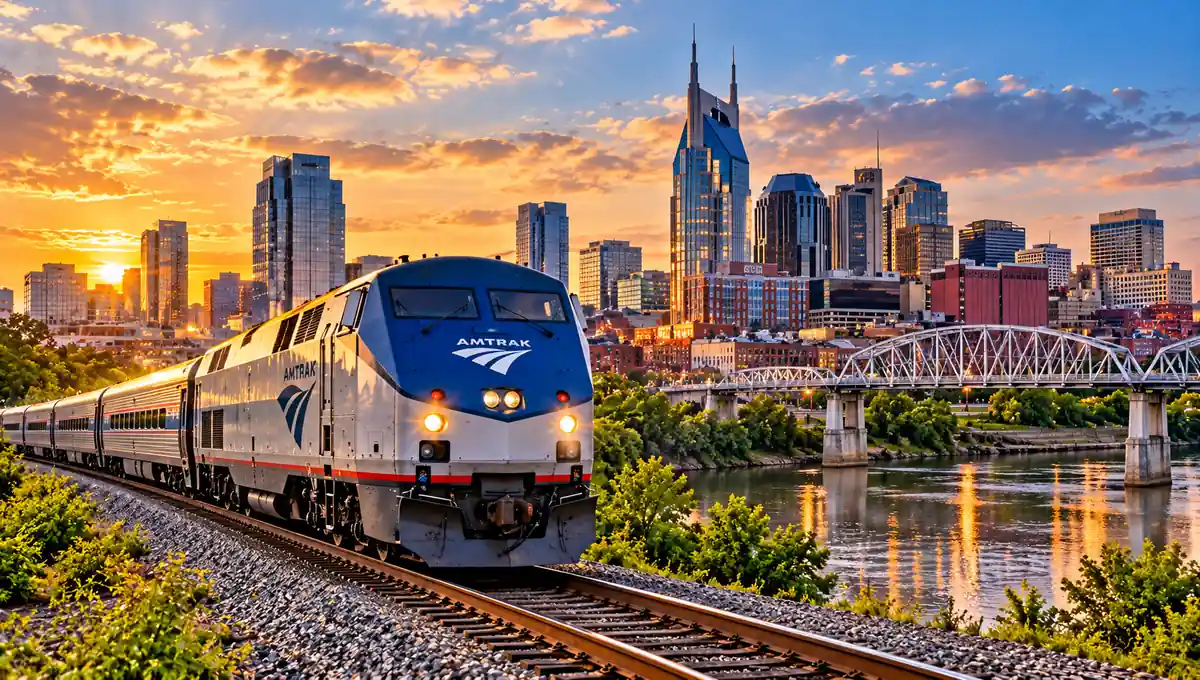
Why Nashville Hasn’t Had Amtrak Service Since 1979
Nashville once had passenger trains connecting it to major American cities.
You could travel by rail to places like Chicago and Florida.
But that changed in October 1979.
Amtrak discontinued its original Floridian, the long-distance train that connected Chicago with Florida through Nashville.
The final service ended on October 9, 1979.
That left Nashville without regular Amtrak passenger service.
Nearly 47 years later, Music City is still waiting for its return.
The beautiful old Union Station building remains downtown, but it now operates as a hotel rather than a working intercity passenger terminal.
Nashville does have the WeGo Star commuter train, which connects downtown with communities to the east.
But that’s not the same as being connected to the national Amtrak network.
Now, several possible routes are giving train supporters something to watch.
Plan 1: Nashville to Atlanta, Chattanooga, and Memphis
This is the most important plan to understand first.
The proposed Atlanta–Chattanooga–Nashville–Memphis corridor was selected for the Federal Railroad Administration’s Corridor Identification and Development Program.
That means it has an established federal planning pathway.
It does not mean construction has been approved or that passenger trains are about to begin running.
✅ Where could you go?
The corridor would connect four major cities:
Atlanta → Chattanooga → Nashville → Memphis
For Nashville residents, that could mean new train trips to Chattanooga and Atlanta in one direction and Memphis in the other.
Think about what that would offer.
You could visit Beale Street without driving across Tennessee.
Travel to Chattanooga for a weekend.
Or head to Atlanta without dealing with interstate traffic yourself.
A train could also give people who cannot or prefer not to drive another transportation option.
✅ How long would Nashville to Atlanta take?
Earlier Amtrak planning concepts modeled a Nashville-to-Atlanta journey of roughly six and a half hours.
That is much longer than driving in light traffic.
So this wouldn’t necessarily be the fastest way to travel.
The appeal would be the ability to relax, read, work, or simply enjoy the trip without driving.
But that six-and-a-half-hour estimate is not a final timetable.
The route, station stops, operating speeds, and number of daily departures would need to be settled through further planning.
✅ Could smaller Tennessee towns get stations?
Possibly.
Places such as Murfreesboro and Tullahoma have appeared in discussions of potential passenger rail connections.
But proposed station locations should not be confused with approved stops.
A final service plan would need to decide which communities the trains would serve.
✅ How far along is this plan?
The City of Chattanooga sponsored the corridor’s successful federal planning application.
The FRA selected it for up to $500,000 in initial Corridor ID funding.
That first step supports early planning work, including developing the scope, schedule, and estimated cost of a more detailed service development plan.
It’s meaningful progress.
But the project still needs much more planning, money, railroad cooperation, and eventually construction before trains can operate.
Status: Selected for a federal passenger rail corridor planning program. No confirmed launch date.
Plan 2: Nashville to Florida and Chicago
Now imagine something completely different.
You board a train in Nashville and travel south toward Florida.
No airport security lines.
No long interstate drive.
Just a train connecting major cities across the country.
The Federal Railroad Administration studied a possible Chicago-to-Miami long-distance route that would pass through Nashville.
✅ What cities would it connect?
The conceptual route includes:
Chicago → Indianapolis → Louisville → Nashville → Chattanooga → Atlanta → Jacksonville → Orlando → Miami
For Nashville travelers, that could open up direct rail connections north to Louisville, Indianapolis, and Chicago.
Heading south, the same route could eventually connect Music City with Atlanta and major Florida destinations.
That’s especially interesting for families who dislike flying or want to make the journey itself part of the vacation.
✅ How long would the trip take?
The FRA’s final long-distance rail study describes a conceptual Chicago-to-Miami route covering approximately 1,531 miles in 36 hours.
That’s the estimated end-to-end journey, not a published train schedule.
A Nashville-to-Florida trip would still take many hours.
This would be long-distance travel, not high-speed rail.
✅ Could you sleep on the train?
Potentially.
Existing Amtrak long-distance trains offer sleeping accommodations on certain routes.
If a Nashville–Florida service were eventually developed, overnight accommodations could be an important feature.
But no train equipment, room types, dining service, or ticket prices have been confirmed for this conceptual route.
So claims that a Nashville sleeper ticket would cost a certain amount—or that a particular lounge car would be included—would be premature.
Isn’t there already an Amtrak train called the Floridian?
Yes, and this is where things can get confusing.
Amtrak currently uses the Floridian name for a Chicago-to-Miami service that travels through Washington, D.C.
That existing train does not pass through Nashville.
The FRA’s studied Chicago-to-Miami option is a different route.
It would reconnect cities along a more direct corridor through Kentucky, Tennessee, and Georgia.
✅ Is this route approved?
No.
The FRA included it among selected preferred options in its national long-distance rail study.
But the agency makes clear that these are conceptual options, not final service proposals.
Further studies, funding, agreements, and project development would be required.
Status: Included in the FRA’s conceptual long-distance rail network. No construction approval or opening date.
Plan 3: Nashville to New Orleans and Detroit
This is the route that could connect several famous American music cities.
Picture boarding in Nashville and traveling south toward Birmingham, Mobile, and New Orleans.
Or heading north toward Louisville, Cincinnati, Columbus, and Detroit.
The FRA studied a Detroit-to-New Orleans long-distance route that would pass through Nashville.
✅ Where would the train go?
The conceptual route would connect major cities including:
Detroit → Columbus → Cincinnati → Louisville → Nashville → Birmingham → Montgomery → Mobile → New Orleans
For travelers, that could create a new north-south connection across the central and southeastern United States.
And the destinations are part of the appeal.
Nashville has country music.
Detroit has Motown.
New Orleans is famous for jazz.
Birmingham and Montgomery offer important civil rights history.
A train connecting these cities could make a fascinating multi-stop vacation.
✅ How long would it take?
The FRA’s study identifies a conceptual Detroit-to-New Orleans route of approximately 1,244 miles.
Earlier planning materials explored possible schedules, but there is no final Nashville-to-New Orleans timetable.
Travelers should not treat estimates such as 11–13 hours as confirmed.
Actual journey times would depend on the route, infrastructure, station stops, and railroad operating agreements.
✅ Why isn’t this train running already?
A route this long would require substantial coordination.
Several cities would need new or upgraded passenger facilities.
Rail infrastructure might need improvements.
And trains would have to share tracks with existing freight operations across multiple states.
The project would also require major funding commitments.
✅ How close is it to becoming real?
Like the Chicago-to-Miami concept, this route appears in the FRA’s national long-distance study.
But being identified in a federal study doesn’t authorize construction.
Status: Conceptual long-distance route identified by the FRA. No confirmed start date.
Plan 4: Nashville to Louisville and Indianapolis
Here’s a smaller idea that could be especially useful for shorter trips.
Imagine taking a morning train from Nashville to Louisville.
You spend the day visiting museums, restaurants, or attractions.
Then you return home without driving Interstate 65.
It’s easy to see why some passenger rail supporters would like this idea.
✅ What is actually being planned?
The important distinction is that the FRA selected a Louisville-to-Indianapolis corridor for its Corridor ID Program.
That is not the same as approving a Nashville-to-Louisville passenger train.
A future extension south through Bowling Green to Nashville has been discussed in regional transportation planning.
But the Nashville extension remains a separate possibility.
✅ How long could Nashville to Louisville take?
Some advocates have discussed a trip of roughly two and a half to three hours.
That could make rail competitive with driving for certain travelers.
However, it is only an illustrative estimate.
There is no approved schedule, frequency, fare, or opening date for a Nashville-to-Louisville service.
✅ Why could this route matter?
A shorter regional train could serve people traveling for work, college, medical appointments, or weekend trips.
It might also provide connections to other Midwest passenger rail services.
But making that happen would require Tennessee and Kentucky to work together on planning and funding.
Status: A Nashville extension is an idea under discussion, not an approved federally selected Nashville corridor.
Which Nashville Train Plan Is Closest to Reality?
Not all four ideas are at the same stage.
Here’s the important comparison.
| Potential service | Planning status |
|---|---|
| Nashville–Chattanooga–Atlanta–Memphis | Selected for FRA Corridor ID planning |
| Nashville–Chicago–Florida | Conceptual FRA long-distance route |
| Nashville–Detroit–New Orleans | Conceptual FRA long-distance route |
| Nashville–Louisville | Possible extension discussed by advocates and planners |
The Atlanta–Chattanooga–Nashville–Memphis project has the clearest formal corridor-development pathway among these four Nashville-focused ideas.
But even that doesn’t mean service is guaranteed.
The others would need additional decisions before becoming construction projects.
Where Would Passengers Board in Nashville?
That’s one of the biggest unanswered questions.
Nashville no longer has an operating Amtrak station.
The historic Union Station building has been repurposed.
Meanwhile, WeGo’s Riverfront Station serves commuter rail, not a full network of long-distance trains.
A future Amtrak station would need to meet the needs of intercity passengers.
Depending on the service, that could involve:
- Accessible boarding platforms and passenger facilities
- Space for ticketing, waiting, and baggage services
- Suitable rail connections and track capacity
- Safe connections to buses, taxis, and local transportation
- Additional equipment servicing or overnight storage facilities where needed
Riverfront Station or another downtown location might be evaluated.
But no final Nashville Amtrak station has been approved for these proposed services.
The Biggest Challenge Might Be Freight Trains
Most people think the hardest part of bringing back passenger rail is buying trains.
But there’s another major obstacle.
The tracks already carry freight.
Railroads such as CSX operate extensive freight networks through Tennessee and neighboring states.
Adding scheduled passenger trains can require new passing tracks, signaling improvements, upgraded infrastructure, and agreements with the companies that own or control the tracks.
Passenger trains need reliable schedules.
Freight railroads need to keep goods moving.
Making those two systems work together is a major part of the planning process.
And that work can be expensive.
Who Would Pay for Nashville’s New Trains?
There isn’t one simple answer.
Shorter state-supported passenger routes generally require financial agreements among the states and agencies involved.
That can include contributions toward operating costs as well as infrastructure.
Long-distance Amtrak services operate under a different federal funding framework.
But that does not mean a new long-distance route automatically receives federal money.
Congress, Amtrak, transportation agencies, and other partners would still have to make important decisions about investment.
The trains also need equipment, stations, and operating agreements.
In other words, a federal study can identify a promising route.
It cannot pay for and launch the entire service by itself.
Does a Federal Rail Study Mean Construction Is Coming?
No.
The FRA’s Corridor Identification and Development Program is designed to help promising rail corridors move through a structured planning process.
The early stages focus on defining the project and developing a detailed service plan.
Later work can include engineering, environmental review, and infrastructure planning.
Projects may then compete for additional funding.
But there is no automatic guarantee that every corridor selected for initial planning will become an operating passenger train.
That’s why claims that Nashville’s new Amtrak service will definitely launch in the early 2030s should be treated cautiously.
There is no confirmed opening year for these four options.
Can You Ride a Train in Nashville Today?
Yes, but not an intercity Amtrak train.
The WeGo Star provides commuter rail service between downtown Nashville and Lebanon, with stops in communities east of the city.
It is primarily designed around local commuting rather than long-distance travel.
For an Amtrak journey, Nashville travelers must currently reach a station outside the city using another transportation option.
If you’re planning a trip, check Amtrak’s current booking system for available bus-and-train connections.
Don’t assume that an older Thruway bus route or connection is still operating on your travel date.
What Happens Next?
The biggest developments to watch are practical ones.
Will the Atlanta–Chattanooga–Nashville–Memphis corridor advance through more detailed planning?
Will states commit money?
Will railroad operators agree on workable passenger schedules?
Will federal officials take any of the conceptual long-distance routes into a formal development program?
And will Nashville identify a realistic location for a new intercity passenger station?
Those decisions will tell us much more than another proposed route map.
The Bottom Line
Nashville has been without regular Amtrak service since October 1979.
That’s a remarkable gap for a growing American city.
But the idea of bringing passenger trains back hasn’t disappeared.
One regional corridor has entered a federal planning program.
Two long-distance routes passing through Nashville have been studied by the FRA.
And a possible connection north toward Louisville continues to attract interest.
Together, these ideas show what Nashville’s passenger rail future could look like.
Trains to Atlanta.
Weekend trips to Memphis.
Overnight journeys toward Florida.
Connections to Chicago, Detroit, and New Orleans.
For now, they’re possibilities—not tickets you can buy.
But after nearly 47 years without Amtrak, even serious planning is worth paying attention to.
If Nashville could bring back just one passenger train route, where would you want it to go first: Atlanta, Memphis, Chicago, or Florida?
Sources
- The FRA confirms the Atlanta–Chattanooga–Nashville–Memphis corridor’s selection for initial Corridor ID funding.
- Its final long-distance study identifies the Chicago–Miami and Detroit–New Orleans route options but explicitly says these are conceptual and require more planning and funding.
- KIPDA confirms that its $500,000 federal planning award covers Louisville–Indianapolis, not Nashville–Louisville.
- Tennessee’s transportation department confirms the existing WeGo Star commuter connection between Nashville and Wilson County.
PortMiami Parking, Hotels and Transportation: Complete 2026 Guide

I Traveled the World to See These 11 Most Beautiful Sculptures — And They Left Me Speechless

10 Country Flags You WON’T BELIEVE Have Hidden Symbols: Number 7 Will SHOCK You!
